 Food & Beverage
How We Helped Counter Culture Coffee Save $1.5M Per Year
Summary
Counter Culture Coffee is one of the most respected specialty coffee roasters in the US, serving wholesale partners, grocery retailers, and direct-to-consumer customers. Leadership saw AI as a way to support that growth without adding back-office overhead. The open question was where to start. The Gnar ran Compass, our AI strategy and roadmap engagement, which mapped how the business runs today, identified every AI opportunity, and laid out the order to pursue them.
The Challenge: How to automate an exceptionally manual business
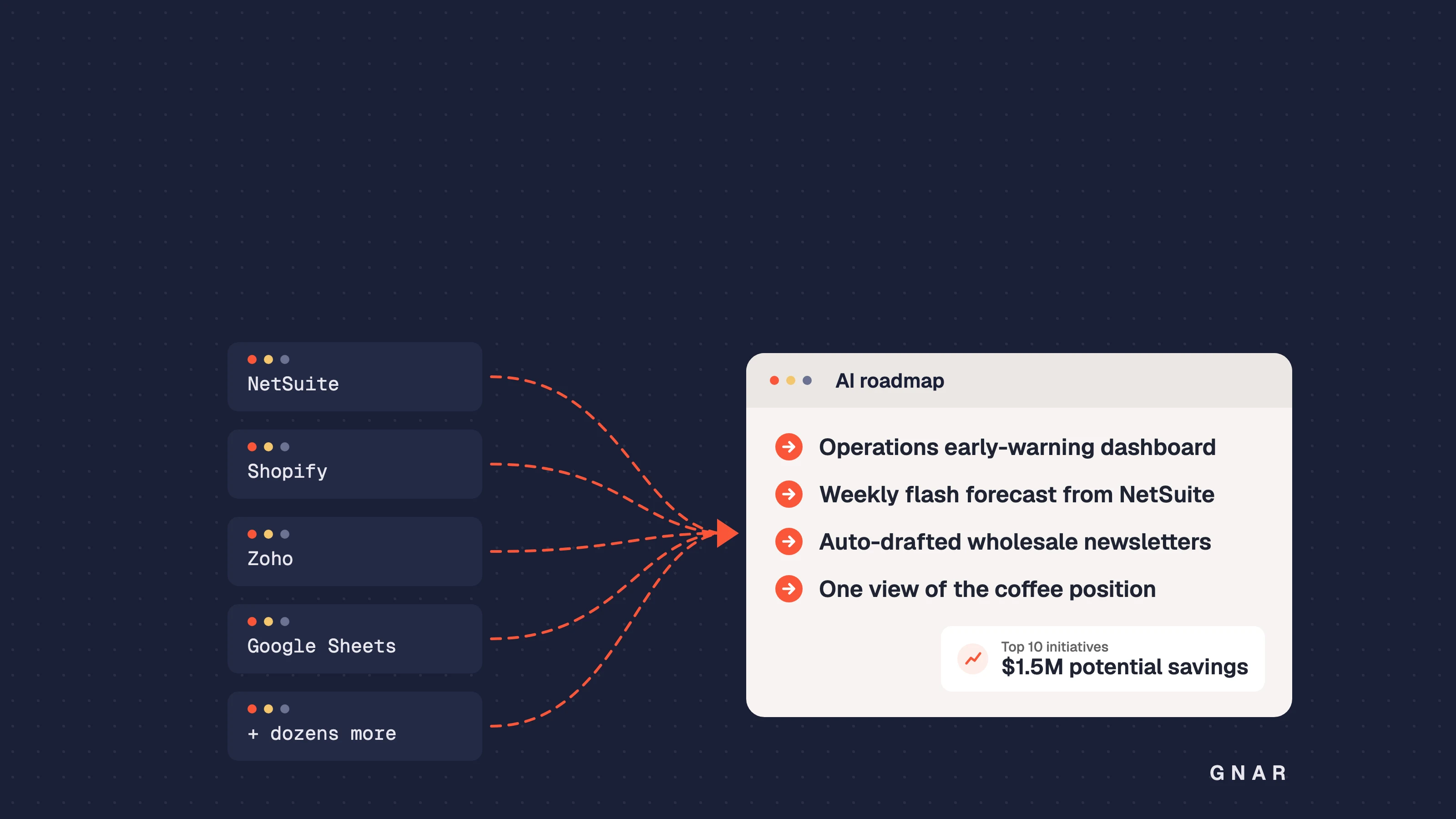
Like many companies that grow channel by channel, Counter Culture built its tool stack function by function. NetSuite serves as the ERP and system of record, Shopify runs direct-to-consumer and B2B commerce, and Zoho supports account management and service. Around them sit dozens of specialized tools for marketing, fulfillment, and operations, with Google Sheets and Excel doing important supporting work.
That setup served the business well, but it made cross-company questions harder than they needed to be. NetSuite is deeply customized to fit how Counter Culture operates, so pulling a reliable number often depended on the few people who knew exactly which fields to use. Some core reference data, like the rotating coffee lineup, was maintained in spreadsheets and entered into other systems by hand.
For AI, that matters. An assistant is only as reliable as the data it reads, and it has no way to know which of two similar fields is the right one. Before investing in AI builds, Counter Culture wanted a clear picture of which opportunities were worth pursuing and what had to be in place for them to work.
The Solution: Artificial intelligence and ERP automation
Compass answers one question: where will AI pay off, and what has to be true first? For Counter Culture, a senior Gnar strategist led the work, with weekly working sessions alongside leadership.
- Interview. 15+ interviews with leadership, department heads, and the operators who run the day-to-day, across finance, operations, coffee procurement, sales, marketing, and data.
- Map. Every system and data flow, end to end, with NetSuite at the center.
- Identify. 79 AI opportunities, catalogued across seven capability areas. Workflow and task automation led with 17, followed by insight generation and analytics (14) and generative content and marketing (13).
- Rank. Every opportunity scored on the same five dimensions: financial ROI, operational efficiency gains, implementation complexity, data readiness, and cultural readiness. Scoring counted only recoverable value, and weak data readiness capped an opportunity's score regardless of its upside.
- Sequence. Remove barriers first, then quick wins for internal champions, while The Gnar builds the larger automations.
The process also tested its own assumptions. Coffee procurement initially looked like a market-timing opportunity. A full year of contract data showed the team was already managing that well, so the recommendation shifted to what would help most: a single, real-time view of the coffee position across contracts, importers, and warehouses.
Inside the systems and data map
The systems map grouped more than 60 tools by function: e-commerce and direct-to-consumer, marketing and creative, operations and finance, account management, and IT and security. Then it traced how each one connects to the core systems. Two insights shaped the roadmap:
- NetSuite is the hub, and that is a strength. Commerce, fulfillment, and retail EDI already flow into a single system of record, which gives AI a natural place to plug in.
- Many tools work from exported data. Outside the core integrations, most tools either stand alone or rely on exports, which is why spreadsheets carry so much of the load.
The companion source-of-truth map reached a clear conclusion: the data foundation is largely sound. A handful of master-data sets were maintained in spreadsheets or kept in more than one system, which meant manual re-keying and reports that did not always match.
The recommendation was to give each of those data sets a single home in a core platform, NetSuite or Zoho, based on which team owns and uses it most, and to retire the spreadsheet and duplicate copies. The rule of thumb behind it: master data is edited only in its system of record, and every other system reads from there.
The Results: a ranked roadmap and a clear first step
Counter Culture left with a prioritized portfolio rather than a wish list, and a shared view of what to do first.
- $1.5M in potential savings across the top 10 initiatives, each with a score, an owner, and a place in the sequence.
- The leverage point, identified. Governing a trusted set of NetSuite data, with agreed definitions and clear ownership, unlocks three builds at once: a plain-language query assistant, an executive scorecard, and automated board reporting.
- A faster month-end close, much of it through configuration. Many of the gains come from NetSuite capabilities Counter Culture already owns, with AI reserved for reconciliations and accrual worksheets.
- A better view for coffee procurement. A consolidated position tool gives buyers one view of contracts, importers, and warehouse inventory, and a foundation that later supports demand planning.
- Quick wins with owners. Four ready-to-build projects, each matched to a named internal owner: an operations early-warning dashboard for promotions, a weekly flash forecast pulled from NetSuite, auto-drafted wholesale newsletters, and equipment marketing assets.
Counter Culture has since referred two other consumer packaged goods companies to The Gnar.
Compass: AI strategy and roadmap
Know that you want to use AI but not sure where to start? We can help.
Start with an AI strategy and roadmap built on your own systems and data.